 |
io-chess
UCI chess engine
|
|
io-chess
UCI chess engine
|
Functions | |
| base_loss_components (pred_wdl, target_wdl, wdl_weight=1.0) | |
| base_loss (pred_wdl, target_wdl, wdl_weight=1.0) | |
| killer_loss (pred_wdl, target_wdl, wdl_weight=1.0) | |
| survivor_loss (pred_wdl, target_wdl, wdl_weight=1.0) | |
| gater_loss (pred_gates, target_gates) | |
| moe_loss (pred_wdl, target_wdl, expert_type='BASE') | |
Variables | |
| int | B = 8 |
| pred_wdl = F.softmax(torch.randn(B, 3), dim=1) | |
| target_wdl = F.softmax(torch.randn(B, 3), dim=1) | |
| loss = moe_loss(pred_wdl, target_wdl, expert_type) | |
| pred_gates = torch.sigmoid(torch.randn(B, 2)) | |
| target_gates = torch.rand(B, 2) | |
| g_loss = gater_loss(pred_gates, target_gates) | |
@file loss.py
@brief Loss functions for training the chess neural network.

Provides functions to compute custom loss metrics combining Win-Draw-Loss (WDL)
probabilities and regularization penalties.
| base_loss | ( | pred_wdl, | |
| target_wdl, | |||
| wdl_weight = 1.0 ) |


| base_loss_components | ( | pred_wdl, | |
| target_wdl, | |||
| wdl_weight = 1.0 ) |
Standard loss for base experts (Tactical, Strategic, Major End, Minor End).

WDL is the primary objective using Brier-style MSE.

Args:
    pred_wdl: [B, 3] predicted WDL probabilities (from softmax)
    target_wdl: [B, 3] target WDL probabilities

Returns:
    (total_loss, weighted_wdl_loss)

| gater_loss | ( | pred_gates, | |
| target_gates ) |
Distillation loss for SmartGater.

Args:
    pred_gates: [B, 2] predicted [survivor, killer] gates
    target_gates: [B, 2] teacher [survivor, killer] gates from C++

Returns:
    Scalar MSE loss
| killer_loss | ( | pred_wdl, | |
| target_wdl, | |||
| wdl_weight = 1.0 ) |
Zoomed loss for Killer expert (winning positions).

KILLER sees positions where STM is winning (eval > 150cp).
Since they will be combined with base experts via residual addition,
the killer expert learns to predict a CORRECTION that emphasizes win certainty.

Zoomed WDL: Maps WinProb [0.60, 1.0] -> [0.0, 1.0]
This creates stronger gradients in winning positions where base experts plateau.

The output should be interpreted as:
- High zoomed_win = "base expert underestimates win probability, add more"
- Low zoomed_win = "base expert is already confident enough"

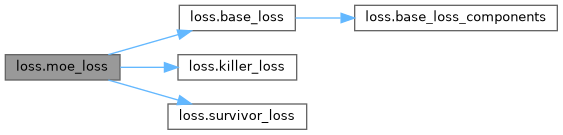
| moe_loss | ( | pred_wdl, | |
| target_wdl, | |||
| expert_type = 'BASE' ) |
Unified loss function with expert type selection.

Args:
    pred_wdl: [B, 3]
    target_wdl: [B, 3]
    expert_type: 'BASE', 'KILLER', or 'SURVIVOR'
| survivor_loss | ( | pred_wdl, | |
| target_wdl, | |||
| wdl_weight = 1.0 ) |
Zoomed loss for Survivor expert (losing positions).

SURVIVOR sees positions where STM is losing (eval < -150cp).
The goal is to find defensive resources - draws or prolonging the game.

Zoomed WDL: Maps LossProb [0.60, 1.0] -> [0.0, 1.0]
Focus: Maximize draw probability, not just predict loss correctly.

The output emphasizes:
- Draw probability as the primary "hope" signal
- Lower zoomed_loss = more swindle potential

| int loss.B = 8 |
| loss.g_loss = gater_loss(pred_gates, target_gates) |
| loss.loss = moe_loss(pred_wdl, target_wdl, expert_type) |
| loss.pred_gates = torch.sigmoid(torch.randn(B, 2)) |
| loss.pred_wdl = F.softmax(torch.randn(B, 3), dim=1) |
| loss.target_gates = torch.rand(B, 2) |
| loss.target_wdl = F.softmax(torch.randn(B, 3), dim=1) |
 1.17.0